C00174: Michael Yaniro and Raphael Taylor
March 6 – 29, 2026
Curated by JJ Manford
Opening reception March 6, 6-8pm
Press Release
Underdonk is pleased to present C00174: Michael Yaniro and Raphael Taylor , a two person exhibition which places Yaniro’s two-dimensional rubber paintings and drawings in dialogue with Taylor’s site specific sculptural installation, with an opening reception at the gallery on Friday, March 6, from 6-8 pm. The show will run from March 6 till March 29, 2026.
Uniting both artists is a vested interest in the mechanization of an image, both physiologically, in terms of how the human eye and brain ‘read’ and image, and metaphorically, in so far as how an image can function as a machine in its capacity to direct the aesthetic experience and intended meaning of information, as well as literal machines. Both Yaniro and Taylor are acutely aware of the hierarchal relationship of relative visibilities between the machine, which performs a function, intended to be invisible, at the service of the visible, legible product. Taylor acknowledges this interest by altering this hierarchy and foregrounding the invisible (machine) as the visible product. Yaniro inverts the directional biases of the aesthetics of prose, which typically renders the page invisible, and upends and fragments the invisible mechanizations of the printed page, thereby making them visible. Both artists are drawn to the aesthetics of the workspace, as both a well of visual material with which to make art, but also, as Taylor puts it, “a place where printers can be found”.
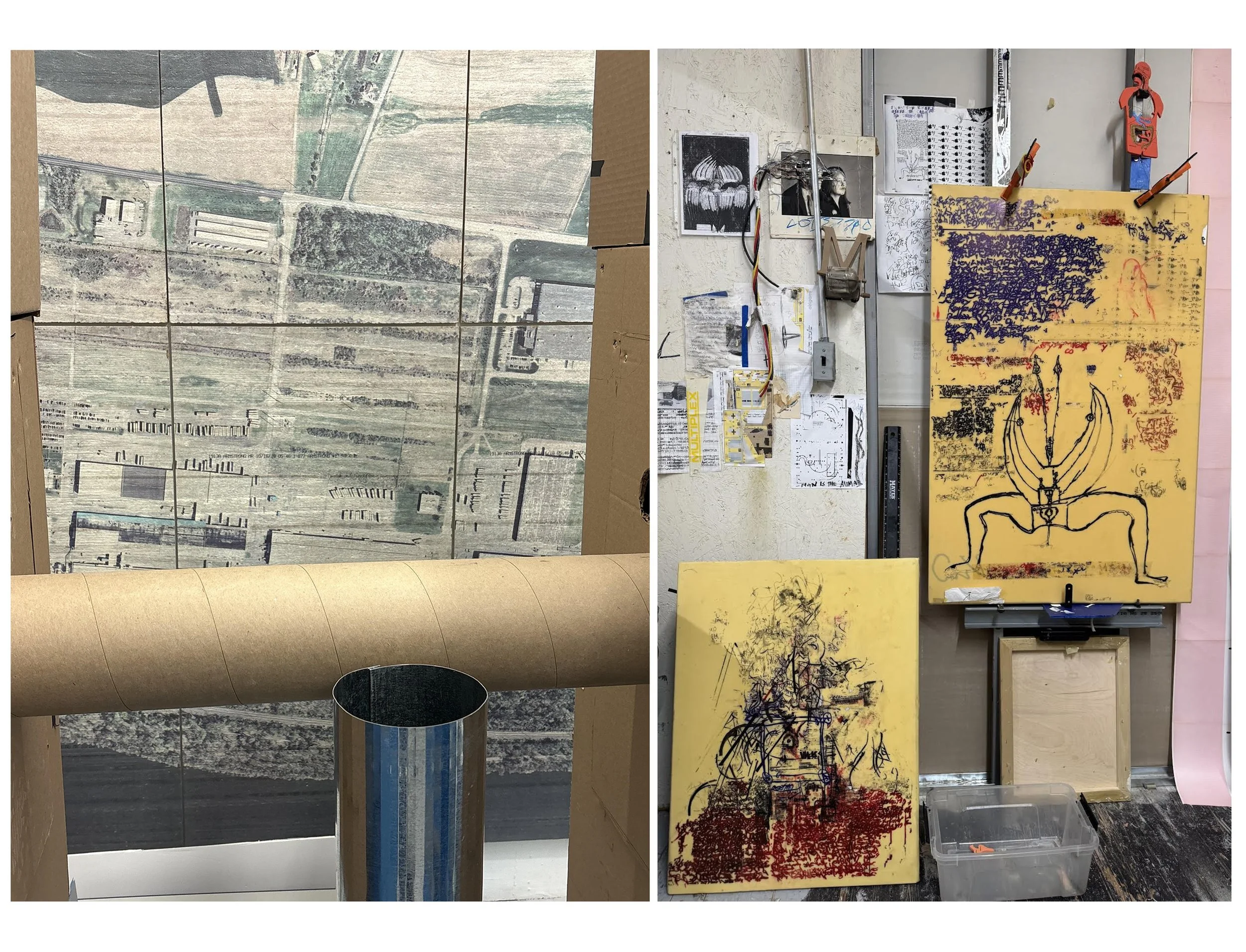
For this body of work, Yaniro has culled heavily from the infinitely fascinating and multifarious detritus accumulating in binders and storage bins he has accumulated since he began practicing in the late 90’s. As he matured, Yaniro began to incorporate ephemera left behind in the disused spaces he inhabited afterwards, as well as the lingering remnants from life events great and small. Building around these fragments, he deliberately, and organically layers his compositions in combination with informal marks , scratches, erasures, his own journal and sketchbook writings, as well as found writings that have been discarded and scattered about the streets of Brooklyn. Often times, the content of these journal entries reflect his basic desires and wants, as though they are prayers to an unspecific god. He then re-writes the words and images onto carbon paper, mediating them through a process of abstraction, making copy after copy, forgetting what he has written as he goes along, and as the writings grow more illegible. In combination with this textural content, he also interjects pictograms, segmented from early anatomical drawings from the Middle Ages. Of specific interest has been the “wound man” motif, and diagrams from more modern sources, specifically those taken from the military industrial complex.
Michael:
I’ve approached every drawing and painting as a page in a book; if the book was a machine. By machine I mean the book’s capacity and method for storing information by arresting the printed word, the flow of speech conveying that information.The book’s mechanism is activated when the reader picks it up, opens the covers and begins to read it. In its most obvious working the book organizes content along three separate modules:
1.) The lateral flow of the line.
2.) The vertical or columnar build up of the lines on a page.
3.) A linear movement organized through depth (sequential arrangements of pages upon pages).
Using these parameters, My intent with these works is to engage the body optically in this most literal, and mechanical way I could, identifying with repetition as much as possible, like the intent is somewhere located between twin brackets of over-identification and under identification.
The fermentation of the installation Raphael has created specifically for this exhibition and space also came out of the inherently mediated mechanizations of memory. Of especial fascination to him was the almost archaic, and analogue nature of this device. The work he has created is made of galvanized steel, sheet metal, rivets, cardboard, UV printed-drop ceiling material, and found text, forming 8 rectilinear forms with connecting cylinders.
Raphael:
I am interested in re-constituting certain objects, systems and environments which most people have not ever seen or which, often because of their own purpose, remain unseen. In this instance, I am working within an absence of memory about a particular, no longer existing printing system, which I encountered and captured in several analogue photographs. Apparatuses like these are a point of convergence between analogue machinery, and digital information. They may be conceived of as places where language and images get put into the physical world through an engineered combination of ink, silicone, cylinders, pressure, and water, but their forms are something separate from what they circulate.
•••
Press: read the NYACA review by Bob Nickas